
Journalists or Content Creators? Bringing validity and truth to the disability narrative
Shelby Wright on the rise of the media created by the disabled community

Hello, Reframers!
Thanks for adding your names to the submission form for Reframing Disability’s Global Directory of Disabled News Media Professionals. I’ve decided to expand the directory to include not just journalists, but all news media professionals, to meet the industry’s needs.
Who is the directory for?
Any disabled professional who can contribute their skills to the news industry, including:
Student and working journalists
Non-fiction filmmakers
Podcasters
Photographers
Photojournalists
Illustrators
Social Media Experts
The aim of the directory is to connect editors, news organisations, and media projects with disabled news media professionals around the world for paid work, collaborations, and commissions. It will live on Reframing Disability’s website and be shared widely, with the hope that it helps reduce some of the structural barriers disabled professionals face, while making it easier for the media to commission more diverse and inclusive journalism.
And the amazing news is that I have already started receiving queries from organisations about commissioning these media professionals, so hurry.
If you haven’t, please fill out the form in the previous issue to get your name added to the directory, preferably by 15th February. The form will be indefinitely open, but updated only occasionally after February.
Will you support the work of Reframing Disability if you value it?
BBC journalist Johny Cassidy says: “The Reframing Disability newsletter really is a great read and something I look forward to reading every time it lands in my inbox. Priti’s doggedness to find and share the stories of brilliant people doing brilliant things to better represent the true side of disability in the media is something I’d recommend to anyone.”
If you’re reading this, you likely find value in this newsletter. Do you value it enough to pay a small sum to support this independent media?
Here are ways you can make a financial contribution:
International
A one time contribution of any amount, or through a custom monthly subscription via this link.
If you prefer PayPal, you can contribute at pritisalian@gmail.com.
Indian
Make a one-time or recurring contribution of any amount using this UPI QR Code:
For contributors in India, a one-time payment of ₹5,000 would be especially helpful. Twenty such contributions would allow me to hire someone part-time for four months.
International contributors, a one-time payment of £50 or $60 would support in the same way.
On another note, my shoulder is healing well. Thank you to everyone who sent such kind notes – they truly helped! Until it’s fully healed, movement is still restricted and painful, so I’m working in smaller bursts and reading more books than usual!
Now, to today’s story.
Shelby Wright is a Missouri-based writer, creator, and advocate. She holds a bachelor’s in political science and a master’s in journalism. Her master’s thesis researched the media created by and shared within the disabled community. The thesis explored historical trauma and marginalisation of the disabled community, and interviewed modern media creators and activists in politics, health, and lifestyle relating to disability. Her work in this area inspired her to create and curate media content that highlights her own disabled life.
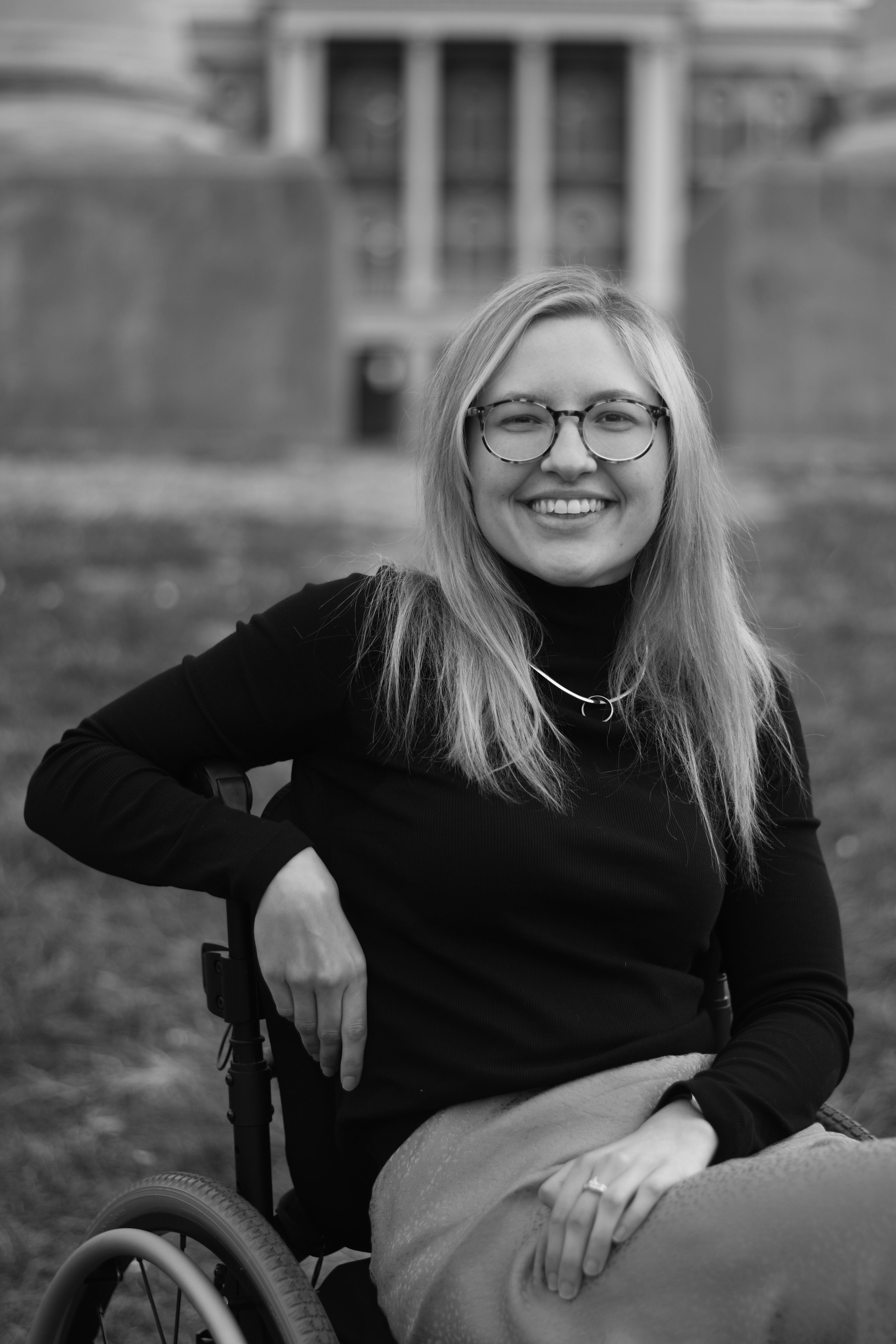
[ID: A black and white shot of Shelby in front of the University of Missouri columns with her right arm propped on the back of her wheelchair. She is a young, white, blonde woman, wearing a black long-sleeve shirt, glasses, and gold necklace.]
Shelby and I met virtually in 2024 through her supervisor Joy Jenkins when Shelby wanted to interview me for the same thesis. While I was the only Asian journalist and creator to be included, Shelby spoke to several from the West. Now that it’s published, Shelby tells Reframing Disability what her research entails!
Shelby’s thesis emerged from a fundamental question that challenged even her journalism school at the University of Missouri-Columbia: what counts as journalism in a rapidly changing media world?
“There was some debate within the journalism school on whether what I was covering was journalism,” says Shelby. She pushed back by pointing to how, fundamentally, the media has shifted. “Journalism is just changing so much,” she says.
“Journalism and media are really in the hands of so many people now that once wasn’t possible,” she explains, recalling when journalists at major outlets “were the deciders of what media was and what society thought.” Today, she argues, “unlike any other time in history, social media empowers individuals in so many ways to create content and share their perspective and their realities for other people.”
Why disabled people turn to content creation
“A lot of people are creating something that did not exist before,” Shelby explains. For many disabled [creators], the media they encountered after their diagnosis “just did not represent them and was not talking to them.”
That absence became a catalyst. “It motivated them to pick up the camera and start sharing how they, and others like them, were [living their life] and doing [things independently].” For people with rare or progressive conditions, “the only material they could find about it was medical communication,” which she describes as “very to the point and negative in some ways, implying you’re not able and not normal.”
“One person told me they didn’t see someone else that was going to college, or exercising, or traveling like they wanted to do.” For many creators, that disconnect is precisely why “they ended up being ‘that’ media creator.”
Shelby interviewed creators like Frankie Perazzola and Sean Baumstark who are reshaping overlooked spaces, particularly fitness. “No one thinks of the next great fitness influencer being disabled,” Shelby notes, yet many creators are “remaking basically the media space dedicated to fitness with disability.”
Some like Noah Griffith and Kelly Berendt are responding to “a void in disability journalism, which is not seen or heard from the perspective of the disability community.”
Accessibility and the role of digital platforms
Accessibility of digital spaces is central to disabled creators going online. “Digital content creation is really accessible for individuals who wouldn’t be seen or heard from otherwise,” Shelby says. Many creators “do not have a journalistic or communications background, but are keen to create media representation through their own lifestyle.”
“For many with limited mobility, [the built environment] is inaccessible and that’s one of the reasons why they haven’t been able to enter traditional journalism.”
She recalls speaking to a sports journalist who wanted to cover a baseball team but couldn’t, because “the stands set up for members of the press were not accessible for wheelchair users.” That exclusion, she says, explains why “there is no disabled journalist covering those things.”
This gap exposes how “accessibility is just an afterthought,” shaping why “media on disability coverage is so scant and so indifferent than what the disabled community needs.”
The impact of inaccurate representation
On an individual level, the impact is isolation. People feel “they aren’t being heard or represented,” and “as a person with a disability they just feel alone.”
Systemically, inaccurate representation reinforces exclusion when accessibility is not given a thought. Disabled people are forced to constantly assess accessibility: “Is the location that I’m going to, accessible? a concern other people just do not even think about.”
These assumptions extend into policy. She explains using a personal example: “Sometimes when people see me and that I have a physical disability, they assume that I am incapable,” adding that policies often lean towards the idea “that a disabled person is almost incapable of achieving.”
Beyond access barriers, Shelby points to political exclusion. Recalling visits to the Missouri State Capitol, she describes its spaces with “not even having curb cuts or ramps,” sending a clear message: “politically, people with disabilities are not welcome.”
A lot of the creators, especially women, Shelby spoke with, reported online gendered abuse as a recurring challenge. Disability in women, she says, is framed as “either not sexual at all, or you’re seen as a sexual ploy to be manipulated and played with,” meaning “you’re not seen as a complete human being.”
Simplification or nuance?
Shelby acknowledges the risk of oversimplification of content by digital creators. But she sees value in it as an entry point for news media. If content “piques reporters’ interest about disability, they’re going to look into it, even if it doesn’t answer all the questions.” They are reporters and will find a way to dig into the issues themselves, she adds.
For many creators, the goal is straightforward: I am sharing basically what is important in my life and the information that I find relevant to be shared. Their audiences include “friends, relatives, onlookers and people curious about disability.”
Can content creators reshape disability journalism?
Shelby is cautiously optimistic. “Traditional journalists are coming to the content creators and [reporting on their work] bringing validity and truth to it,” she says. Publications like New York Times and Washington Post have had disability reporters for a while now. “The existence of Reframing Disability proves there is a platform and audience for journalism about disability.”
What matters most, she insists, is the approach. “Journalism must learn to speak to and with the disabled community and not just about them.”
“Media representation on the disabled front has changed so much just in the last ten years,” Shelby says. “I think it’s only going to get better.”
Shelby’s recommendations
Creators to follow
Journalist Madison Lawson who has contributed to Vogue, Teen Vogue, Allure and Glamour.
Jesi Stacham who is “helping shift the mindset from victim to victor so you create the life of your dreams.”
Health and wellness disability advocate Kerry Peterson.
Creator and speaker Amanda Steijlen.
Memoirs
Sitting Pretty: A View From My Ordinary Resilient Disabled Body is a memoir-in-essays from disability advocate and creator of the Instagram account
@sitting_pretty, Rebekah Taussig, processing a lifetime of memories to paint a
beautiful, nuanced portrait of a body that looks and moves differently than
most.Riva Lehrer’s memoir Golem Girl is vividly told and gloriously illustrated. Riva is an artist born with disabilities who searches for freedom and connection in a society afraid of strange bodies.
Podcasts
The Adaptive Athlete Podcast is dedicated to sharing the stories of athletes in the Crossfit space and beyond who have pushed past the limits doctors or others gave them.
The Accessible Stall Podcast includes conversations on disability hosted by Kyle Khachadurian and Emily Ladau that keeps it real about issues within the disability community.
ICYMI (In Case You Missed It)
In case you missed recent editions, read what journalists have to say about the future of mental health and disability inclusion in news media and how disabled-led media will shape the future of journalism.
Thanks for reading, or listening to this issue (on the Substack app). As always, press reply to share your thoughts —I love to hear from you! I’m also available on LinkedIn and Instagram and Reframing Disability has an Instagram account too – follow and engage!
I was on this website, and reading it again here was refreshing for memory - enlightening for knowledge. Thank you, Priti. And please up the reframing narratives
Thank you so much for re-sharing this conversation. I was up early that day in the Washington DC area to participate in the original meeting, and it was lovely to meet the other participants, as well. I landed here from opening the infographic in your email newsletter. I opened that first before realizing it was from your workshop. I wondered how my own social media practices while navigating a disability align with the recommendations. Fortunately, a lot has improved for me in managing my disability since the original conversation, but my social media practices are still closely aligned with Puneet and Soumita's. It is a place to authentically reflect and to connect with others who value math accessibility.
Thank you for your advocacy and your work - it is truly making a difference around the globe!
Sara